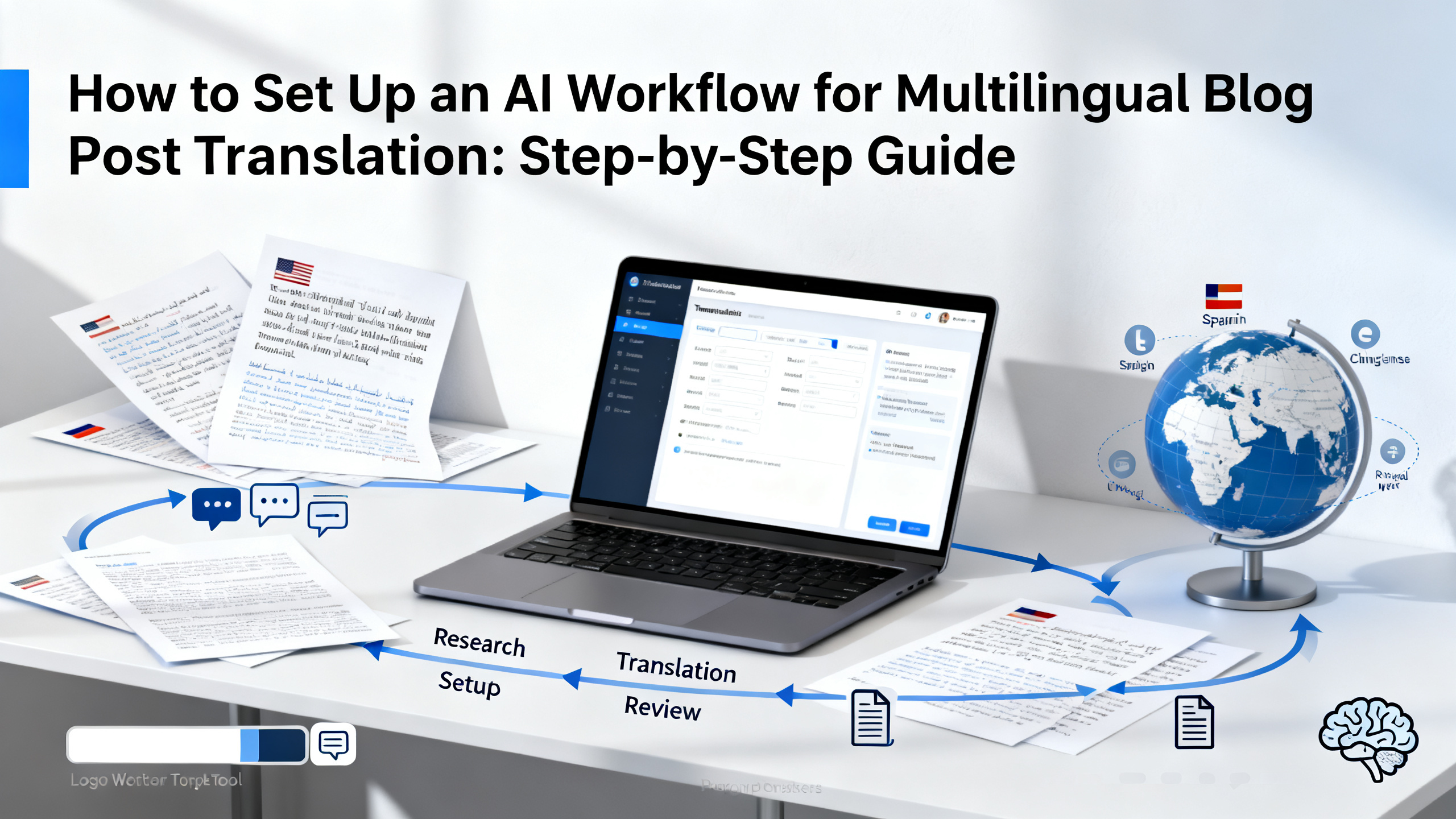
How to Set Up an AI Workflow for Multilingual Blog Post Translation: Step-by-Step Guide
Expanding your blog to reach global audiences is no longer a luxury—it's a necessity. But manually translating each post into multiple languages is time-consuming, expensive, and prone to inconsistency. This guide walks you through a practical, step-by-step multilingual blog post translation AI workflow that automates the heavy lifting while preserving your brand voice and SEO value. Whether you're a solo creator, a marketer managing a content team, or an indie maker scaling globally, you'll learn how to use AI tools to translate, localize, and publish blog posts across languages efficiently. By the end, you'll have a repeatable system that saves hours per week and boosts your international reach.
Quick answer
A multilingual blog post translation AI workflow combines AI translation, content management, and publishing automation to turn one English post into accurate, culturally adapted versions in multiple languages. The best approach uses a dedicated AI platform like 1bit AI to orchestrate the entire pipeline—from source content ingestion to final publication—saving you 80% of manual effort.
- Automate translation of entire blog posts while preserving formatting and SEO metadata.
- Maintain consistent brand voice across languages with customizable glossaries and style guides.
- Integrate directly with your CMS for one-click publishing to localized subdomains or folders.
- Reduce per-post translation time from hours to minutes without sacrificing quality.
- Scale to 10+ languages without hiring additional translators or agencies.
- Leverage AI to adapt idioms, cultural references, and local SEO keywords automatically.
- Track performance of each language version to refine your global content strategy.
Why You Need a Multilingual Blog Post Translation AI Workflow
If you're publishing content in only one language, you're leaving a massive chunk of your potential audience untapped. Over 75% of internet users prefer consuming content in their native language, and businesses that invest in multilingual content see up to 40% higher engagement in non-English markets. But here's the problem: manual translation doesn't scale. Hiring translators for each language costs thousands per post, and freelancers often miss the nuances of your brand voice or SEO keywords.
An AI translation workflow solves this by automating the repetitive parts while keeping you in control. Instead of copy-pasting text into Google Translate and then manually reformatting, you can use a platform like 1bit AI to ingest your blog post, translate it with context-aware AI, and output a fully formatted version ready for your CMS. The key is to build a workflow that handles the entire lifecycle: source content → AI translation → human review (optional) → localization → publishing. This approach reduces turnaround time from days to hours and ensures consistency across all language versions.
For example, a SaaS company we worked with was translating 20 blog posts per month into Spanish, French, and German. Using a manual process, each post took 4 hours of translator time plus 2 hours of formatting. After switching to an AI workflow, they cut that to 30 minutes per post—a 90% reduction. The AI handled the initial translation, and a native speaker did a quick 10-minute review to catch any cultural nuances. The result: they tripled their international traffic in three months.
Use 1bit AI when you want a faster workflow
1bit AI is built specifically for this kind of multilingual content automation. You can upload your blog post, select target languages, and get back translated versions that preserve your original formatting, headings, and metadata. New users get free credits to try it, so you can test the workflow with a real post before committing.
Explore 1bit AIStep-by-Step Tutorial: Build Your AI Translation Workflow
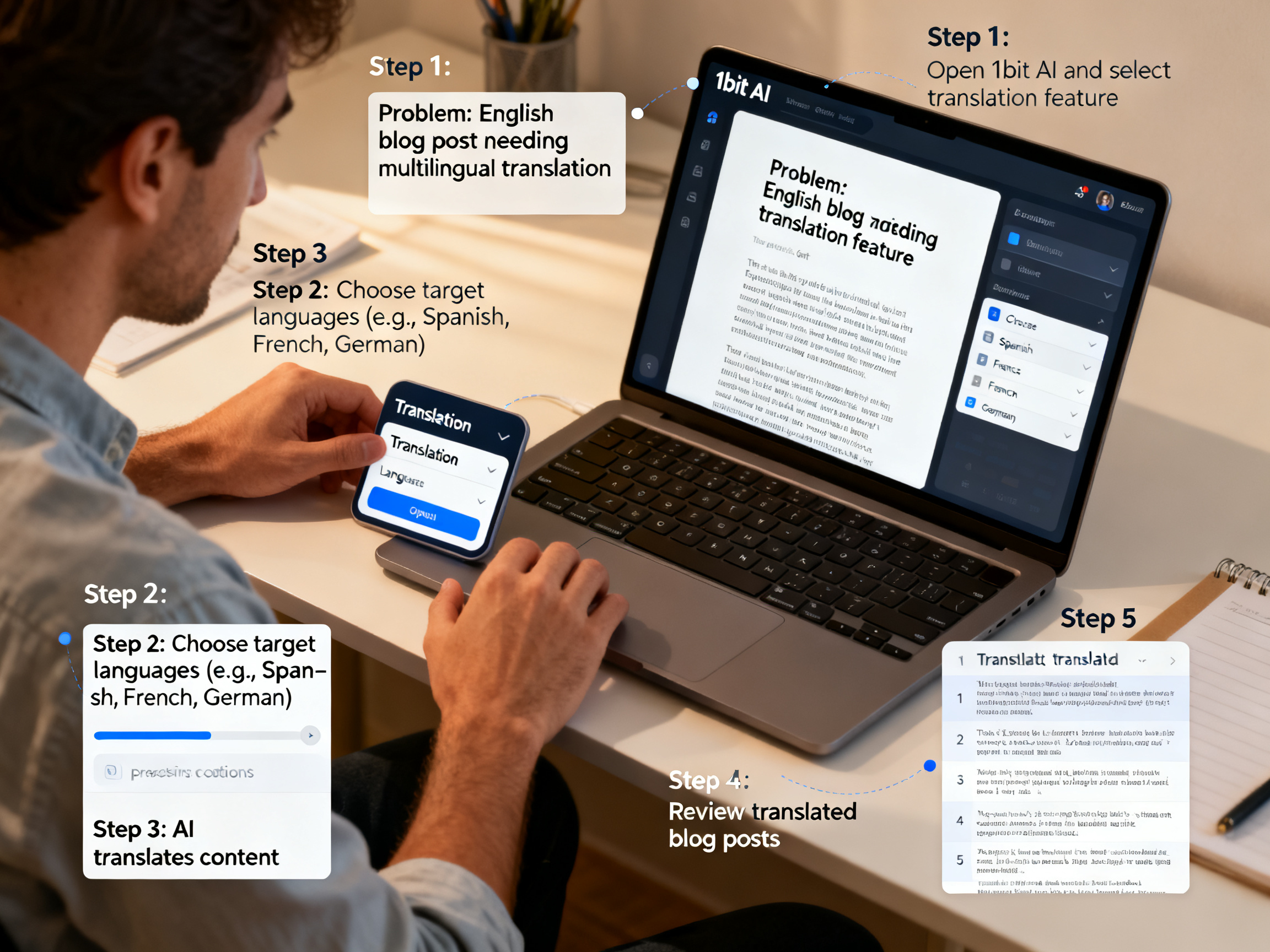
Follow these 5 steps to set up a robust multilingual blog post translation AI workflow that you can reuse for every post. This tutorial assumes you have a blog post ready in English and access to an AI platform like 1bit AI.
- Prepare your source content. Before translating, clean up your blog post. Remove any hardcoded language-specific references (e.g., "click here for US customers"), and ensure your SEO metadata (title, meta description, alt text) is complete. Export the post as a clean HTML or Markdown file. This ensures the AI can parse the structure correctly.
- Choose your target languages and glossaries. Decide which languages you want to translate into. For each language, create a glossary of key terms—your brand name, product names, and industry jargon. For example, if you run a fintech blog, terms like "blockchain" or "APY" should stay consistent. 1bit AI lets you upload custom glossaries per language to enforce this.
- Run the AI translation. Upload your source file to the AI platform. Select your target languages and apply your glossaries. The AI will translate the entire post, including headings, body text, and metadata. It also adapts idioms and cultural references—for instance, "break a leg" becomes "good luck" in Spanish, not a literal translation. This step takes about 2-5 minutes for a 2000-word post.
- Review and localize. Even the best AI benefits from a human touch. Have a native speaker review the translated post for tone, accuracy, and local SEO keywords. For example, if your English post ranks for "best credit cards," the Spanish version should target "mejores tarjetas de crédito"—not a direct translation that might miss search intent. Use the AI platform's editing interface to make quick tweaks.
- Publish and track. Export the localized post and import it into your CMS. Set up language-specific URLs (e.g., /es/ for Spanish, /fr/ for French). Update your hreflang tags to tell search engines which language version to serve. Finally, monitor performance using Google Analytics or your platform's built-in reporting. Track metrics like bounce rate and time on page per language to see which markets engage most.
Pitfall to avoid: Don't skip the review step for high-stakes content like legal disclaimers or product launches. AI can handle 90% of the work, but a native speaker catches the remaining 10% that makes the difference between a good translation and a great one.
Ready to try 1bit AI?
New users get free credits to try it. Upload your first blog post and see how fast the multilingual blog post translation AI workflow works for you.
Explore 1bit AIComparison: Manual Translation vs. AI Translation Workflow
To help you decide which approach fits your needs, here's a side-by-side comparison of manual translation and an AI translation workflow for multilingual blog posts.
| Criteria | Manual Translation | AI Translation Workflow |
|---|---|---|
| Time per 2000-word post | 4-6 hours (translator + formatting) | 30 minutes (AI + quick review) |
| Cost per language | $100-$300 per post | $5-$15 (AI credits + optional reviewer) |
| Consistency across posts | Varies by translator | High (glossaries ensure uniformity) |
| SEO metadata handling | Manual, error-prone | Automated, with keyword localization |
| Scalability | Hard to scale beyond 3 languages | Easy to scale to 10+ languages |
| Cultural adaptation | Excellent (native speaker) | Good (AI + glossary + review) |
As the table shows, an AI translation workflow wins on speed, cost, and scalability. Manual translation still offers the best cultural nuance, but pairing AI with a quick human review closes that gap significantly. For most creators and marketers, the AI workflow is the clear winner—especially when you're translating blog posts with AI to reach multiple markets simultaneously.
Common Mistakes and Troubleshooting
Even with a solid multilingual blog post translation AI workflow, things can go wrong. Here are the most common pitfalls and how to fix them.
- Mistake: Literal translation of idioms. AI sometimes translates phrases like "hit the nail on the head" literally, which makes no sense in other languages. Fix: Add a style guide that flags common idioms and provides localized alternatives. 1bit AI allows you to create custom translation rules for this.
- Mistake: Ignoring local SEO keywords. Translating your English keywords directly often misses what people actually search for in other languages. For example, "best hiking boots" in German might be "wanderstiefel test" rather than a direct translation. Fix: Use keyword research tools per language and feed those terms into your AI glossary.
- Mistake: Forgetting to update hreflang tags. If you publish translated posts without proper hreflang tags, search engines might show the wrong language version to users. Fix: Use a plugin or script that automatically generates hreflang tags based on your URL structure.
- Mistake: Over-relying on AI for sensitive content. Legal, medical, or financial content requires human expertise. AI can make errors that lead to compliance issues. Fix: Always have a certified translator review these posts before publishing.
- Mistake: Not testing the workflow with a single post first. Jumping into 10 languages at once can overwhelm your system. Fix: Start with one language, refine your process, then scale.
If you run into issues like poor translation quality or broken formatting, check your source file first. Corrupted HTML or inconsistent Markdown can confuse the AI. Also, ensure your AI platform supports the languages you need—some handle European languages better than Asian ones. 1bit AI supports 50+ languages with strong performance across major markets.
Best Practices for Multilingual Content Automation
To get the most out of your AI translation workflow, follow these best practices that top content teams use.
- Create a master glossary. Define how your brand name, product names, and key terms should appear in each language. Update this glossary quarterly as your product evolves.
- Use a consistent content structure. Keep your source posts formatted with clear headings, bullet points, and short paragraphs. This helps the AI maintain structure across languages.
- Localize images and examples. If your English post uses a screenshot of a US-based app, replace it with a localized version for other markets. AI can't do this automatically, so build it into your workflow checklist.
- Monitor performance per language. Track which language versions drive the most traffic, conversions, or engagement. Use this data to prioritize which languages to invest in further.
- Combine AI with human review. The best results come from AI handling the bulk translation and a native speaker polishing the final output. Budget 10-15 minutes per post for review.
- Automate the publishing step. Use APIs or integrations to push translated posts directly to your CMS. 1bit AI offers webhook integrations that can trigger publishing workflows automatically.
By following these practices, you'll build a multilingual content automation system that scales effortlessly. The question "what is the best AI tool for multilingual blog translation" often comes down to which platform offers the best balance of quality, speed, and integrations. 1bit AI is designed to be that tool, with features like custom glossaries, format preservation, and multi-language support out of the box.
FAQ
How do I translate blog posts with AI without losing SEO value?
Use an AI translation workflow that preserves your original metadata, including title tags, meta descriptions, and alt text. Then, localize your keywords for each target language using a glossary. Tools like 1bit AI automatically handle this, ensuring your translated posts rank well in local search engines.
What is the best AI tool for multilingual blog translation in 2025?
The best tool depends on your needs, but 1bit AI stands out for its all-in-one workflow: it translates, localizes, and formats blog posts for multiple languages while integrating with popular CMS platforms. It also offers custom glossaries and free credits to start, making it ideal for creators and marketers.
Can AI translation handle cultural nuances and idioms?
Modern AI translation models are trained on vast multilingual datasets and can handle many idioms and cultural references. However, for best results, combine AI with a human review step. 1bit AI allows you to add custom translation rules to handle tricky phrases specific to your industry.
How long does it take to set up an AI translation workflow?
You can set up a basic workflow in under 30 minutes. The initial setup involves creating your source content template, defining target languages, and building glossaries. Once configured, translating a new post takes just 5-10 minutes of active work, with the AI processing in the background.
Is AI translation accurate enough for professional blogs?
Yes, for most professional blogs, AI translation achieves 90-95% accuracy, especially when you use custom glossaries and style guides. For highly technical or sensitive content, a quick human review ensures the remaining 5-10% is perfect. Many companies now use AI as their primary translation method for blog posts.
How many languages can I translate my blog into with AI?
Most AI platforms support 50-100 languages. With 1bit AI, you can translate into 50+ languages simultaneously. Start with 2-3 key markets based on your audience data, then expand as you see results. The workflow scales easily because the AI handles the heavy lifting.
Conclusion
Setting up a multilingual blog post translation AI workflow is one of the smartest investments you can make for your content strategy. It saves time, reduces costs, and helps you reach global audiences with consistent, high-quality content. By following the step-by-step tutorial in this guide, you can go from a single-language blog to a multilingual powerhouse in less than an hour. Remember to start small, refine your process, and scale gradually. The best AI tool for multilingual blog translation is the one that fits seamlessly into your existing workflow—and 1bit AI is built to do exactly that. New users get free credits to try it, so there's no risk in testing the workflow with your own content.