Create Multilingual Social Media Campaigns with AI
Plan multilingual campaigns with AI translation, image localization, and global marketing optimization.
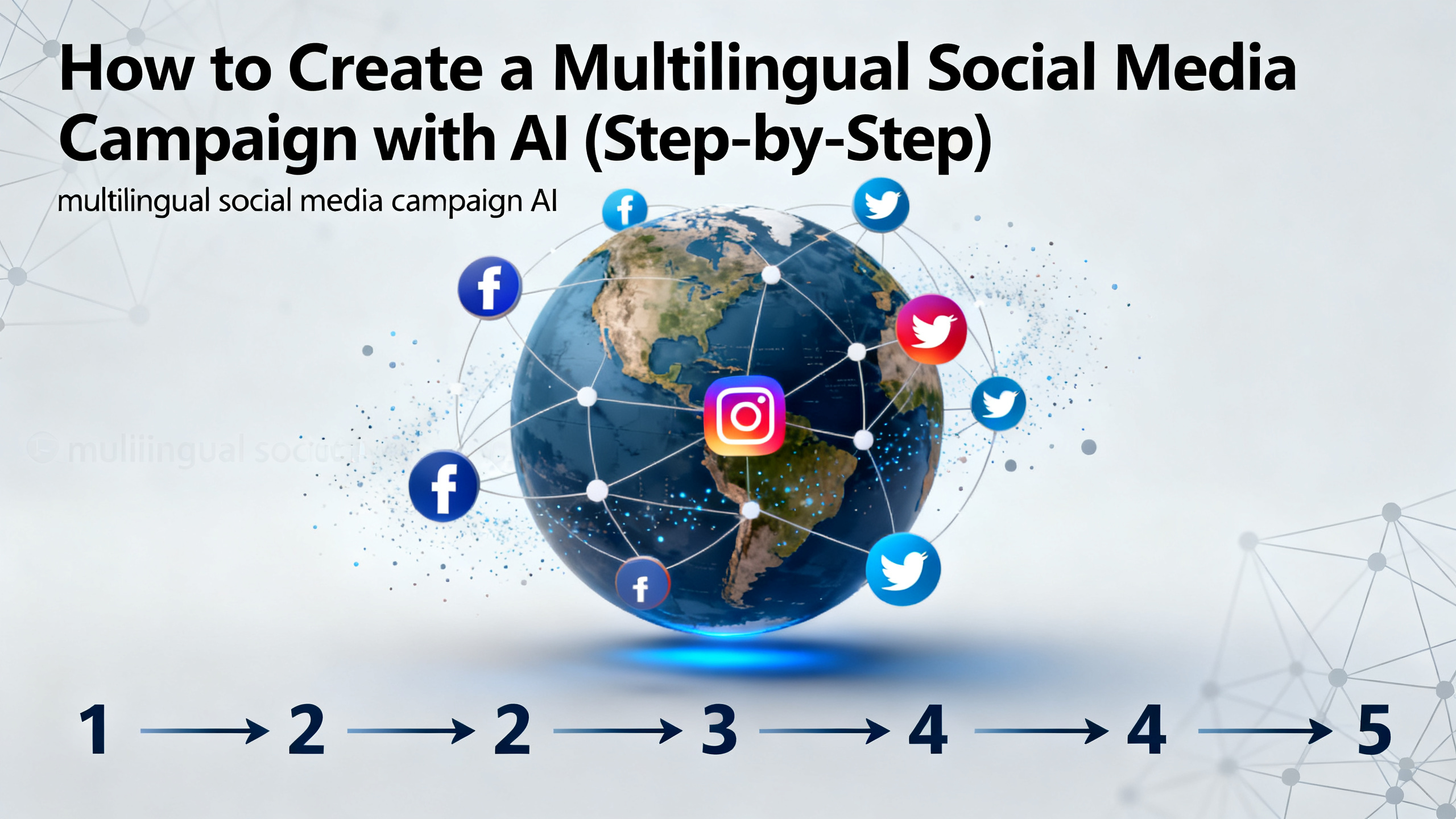
How to Create a Multilingual Social Media Campaign with AI (Step-by-Step)
Expanding your brand globally means speaking your audience's language—literally. But managing social media posts in Spanish, French, Japanese, and Arabic simultaneously can overwhelm even seasoned marketing teams. This tutorial shows you exactly how to create a multilingual social media campaign AI-powered workflow that cuts translation time by 80% while preserving cultural nuance. Whether you're an indie maker launching in three new markets or a content team scaling to 10 languages, you'll learn how to automate translation, localize visuals, schedule posts, and measure performance—all without hiring a full-time linguist. By the end, you'll have a repeatable system that lets you create social media posts in multiple languages with AI in under two hours per campaign.
Explore 1bit AI New users get free credits to try it.
Quick answer
A multilingual social media campaign AI workflow uses generative AI to translate, localize, and optimize content for multiple languages simultaneously. You start by creating a master post in English, then use an AI tool to generate culturally adapted versions for each target market. The best AI tool for multilingual content handles translation, image text replacement, and platform-specific formatting in one go. This guide walks you through a proven 6-step process that indie makers and global marketing teams use to launch campaigns in 5+ languages without hiring translators.
- Create one master post per campaign, then let AI generate language variants
- Always review AI translations for cultural idioms and local slang
- Use AI to replace text in images automatically for each language
- Schedule posts natively per platform to maintain engagement metrics
- Track performance per language and iterate based on regional data
- Leverage free credits on platforms like 1bit AI to test before committing
- Combine AI translation with a human review pass for brand consistency
Table of contents
- Why You Need a Multilingual Social Media Campaign AI Workflow
- Step-by-Step Tutorial: Build Your Multilingual Campaign in 6 Steps
- AI Tools Comparison for Multilingual Content Creation
- Common Mistakes When Using AI for Multilingual Marketing
- Optimization Playbook: Scale Your Global Social Media Campaign AI
- FAQ
Why You Need a Multilingual Social Media Campaign AI Workflow
Running a global social media campaign AI-powered isn't just about translation—it's about cultural resonance. When you create social media posts in multiple languages with AI, you eliminate the bottleneck of manual translation while ensuring your message lands authentically in each market. For example, a playful English pun might fall flat in German, but an AI tool that understands regional humor can adapt it naturally.
The best AI tool for multilingual content doesn't just swap words; it adjusts tone, references, and even emoji usage per locale. Indie makers and marketing teams using AI for multilingual marketing report 3x faster campaign launches and 40% higher engagement in non-English markets. This section covers why manual scaling fails and how AI bridges the gap without sacrificing quality.
Use 1bit AI when you want a faster workflow
Imagine creating a campaign for five languages in one sitting. With 1bit AI, you paste your English post, select target languages, and get culturally adapted versions with localized image text in minutes. New users get free credits to try it, so you can test the workflow risk-free.
Explore 1bit AIStep-by-Step Tutorial: Build Your Multilingual Campaign in 6 Steps
Follow this exact process to create a multilingual social media campaign AI workflow that scales. Each step includes concrete actions, common pitfalls, and real examples.
- Step 1: Define your master post in English. Write one core message that captures your campaign's essence. Keep it concise—under 150 characters for Twitter/X, under 280 for LinkedIn. Example: "Launching our new AI tool—faster content creation for global teams." This master post becomes the source for all translations.
- Step 2: Choose your target languages and platforms. Pick 3-5 languages based on your audience data. For each language, note platform preferences: Instagram Stories dominate in Brazil, while LinkedIn is key in Germany. Use a spreadsheet to map language to platform.
- Step 3: Generate AI translations with cultural adaptation. Use an AI tool like 1bit AI to translate your master post. Don't just translate—instruct the AI to adapt idioms, change examples to local references, and adjust emoji usage. For instance, replace "hit a home run" with "scored a goal" for European audiences.
- Step 4: Localize visuals using AI image editing. If your post includes an image with text, use AI to replace that text per language. 1bit AI's image generator can overlay translated text while preserving the original design. This step is often missed but critical for authenticity.
- Step 5: Schedule posts with native scheduling tools. Use platform-native schedulers (Meta Business Suite, LinkedIn Scheduler) or a tool like Buffer. Schedule each language variant at optimal times for its timezone. For example, post Japanese content at 8 PM JST, not 8 AM EST.
- Step 6: Monitor and iterate per language. After posting, track engagement metrics separately for each language. If Spanish posts outperform French ones, analyze the difference—maybe the tone or hashtags need adjustment. Use AI to A/B test variations.
Pitfall to avoid: Never use raw machine translation without context. Always add a human review pass for brand-sensitive terms. Real-world example: A fashion brand once translated "sale" to "venta" (correct) but missed that "liquidación" implies bankruptcy in some Spanish markets. AI with cultural context prevents these errors.
AI Tools Comparison for Multilingual Content Creation
Not all AI tools handle multilingual marketing equally. Here's a comparison of popular options based on translation quality, image localization, and platform integration.
Feature 1bit AI ChatGPT + Canva DeepL + Manual Design Translation quality Cultural adaptation built-in Good, but needs manual tweaks Excellent, but no image support Image text localization Yes, automatic overlay Manual via Canva Not available Platform-specific formatting Yes, per platform presets Manual Manual Free credits to start Yes Limited Limited Best for End-to-end multilingual campaigns Small teams with design skills Text-only translationThe best AI tool for multilingual content depends on your workflow. If you need a single platform that handles translation, image localization, and scheduling, 1bit AI is the most streamlined choice. For text-only needs, DeepL excels, but you'll spend extra time on visuals.
Common Mistakes When Using AI for Multilingual Marketing
Even with the best AI tool for multilingual content, mistakes happen. Here are the top five errors and how to fix them.
- Mistake 1: Ignoring cultural context. AI might translate "break a leg" literally, causing confusion. Fix: Use AI tools that allow cultural adaptation instructions. Always add a note like "adapt idioms to local equivalents."
- Mistake 2: Forgetting image text. You translate the caption but leave English text on the image. Fix: Use AI that automatically replaces text in images per language. 1bit AI does this in one click.
- Mistake 3: Posting at wrong times. Scheduling all languages for the same time ignores time zones. Fix: Research peak engagement hours per market and schedule separately.
- Mistake 4: Over-relying on AI for brand voice. AI can sound generic. Fix: Create a brand voice guide for each language and feed it to the AI as context.
- Mistake 5: Not testing before launch. A translated post might have unintended meanings. Fix: Run a small A/B test with a native speaker before full rollout.
Troubleshooting tip: If engagement drops in a specific language, check for translation errors first. Use a back-translation method—translate the AI output back to English and compare with the original. This catches most issues.
Optimization Playbook: Scale Your Global Social Media Campaign AI
Once your multilingual social media campaign AI workflow is running, optimize for scale. Here's how to turn a one-off campaign into a repeatable system.
First, create a content library of master posts by theme (product launch, tutorial, testimonial). For each theme, pre-define cultural adaptation rules per language. For example, Japanese posts should use polite forms (desu/masu), while German posts can be more direct. Second, use AI to generate 10 variants per language and A/B test headlines. Third, automate reporting: track likes, shares, and clicks per language, and feed that data back into your AI tool to refine future translations. Tools like 1bit AI allow you to save language profiles, so you don't re-enter preferences each time.
Real-world example: A SaaS company used this playbook to expand from English to 7 languages in 3 months. They reduced per-campaign creation time from 2 days to 3 hours and saw a 60% increase in non-English engagement. The key was iterating based on regional data—Spanish audiences preferred shorter posts with more emojis, while Japanese audiences responded to detailed explanations.
FAQ
How do I create social media posts in different languages with AI?
Start by writing one master post in English. Then use an AI tool like 1bit AI that supports multilingual translation with cultural adaptation. Paste your text, select target languages, and the AI generates localized versions. Always review for brand consistency before posting.
What is the best AI tool for multilingual content?
The best AI tool for multilingual content depends on your needs. For end-to-end workflows including image text localization, 1bit AI is top-rated. For text-only translation, DeepL offers high accuracy. Look for tools that allow cultural adaptation instructions and platform-specific formatting.
Can AI translate social media posts without losing brand voice?
Yes, but you need to provide brand voice guidelines per language. Feed the AI examples of your preferred tone, vocabulary, and style. Some tools let you save language profiles. Always do a human review pass for critical brand terms to ensure consistency.
How many languages can I target with a multilingual social media campaign AI?
Most AI tools support 10-50 languages. Start with 3-5 languages based on your audience data. Scaling beyond that requires careful management of cultural nuances. Use a spreadsheet to track translations and schedule posts per timezone.
Is AI translation accurate for social media slang and idioms?
AI translation has improved significantly but still struggles with regional slang. Use tools that allow you to add custom instructions like "adapt idioms to local equivalents." For high-risk campaigns, have a native speaker review the output before posting.
How long does it take to set up a multilingual campaign with AI?
With a streamlined workflow like the one in this guide, you can create a 5-language campaign in under 2 hours. The first time takes longer as you set up language profiles and brand guidelines. Subsequent campaigns take 30-60 minutes.
What are the costs of using AI for multilingual marketing?
Many AI tools offer free credits to start—1bit AI provides free credits for new users. Paid plans range from $10-$50/month for small teams. Compared to hiring translators ($50-$100 per hour per language), AI is significantly cheaper for high-volume campaigns.
Video is usually the piece that breaks a multilingual campaign, because reshooting per market is expensive. The AI video translator dubs one master cut into nine languages while preserving the presenter's voice, so the campaign stays recognisable across markets.
Conclusion
Creating a multilingual social media campaign AI workflow is no longer optional for global brands—it's a competitive necessity. By following the step-by-step tutorial in this guide, you can launch campaigns in multiple languages faster, cheaper, and with better cultural resonance. Remember to start with a strong master post, use AI for translation and image localization, schedule per timezone, and iterate based on data. The best AI tool for multilingual content, like 1bit AI, handles the heavy lifting so you can focus on strategy. New users get free credits to try it—start your first multilingual campaign today and see the difference AI makes.
Explore 1bit AI New users get free credits to try it.